
Plant Preservative Mixture (PPM™)
Plant Preservative Mixture (PPM™)
Couldn't load pickup availability
What is Plant Preservative Mixture?
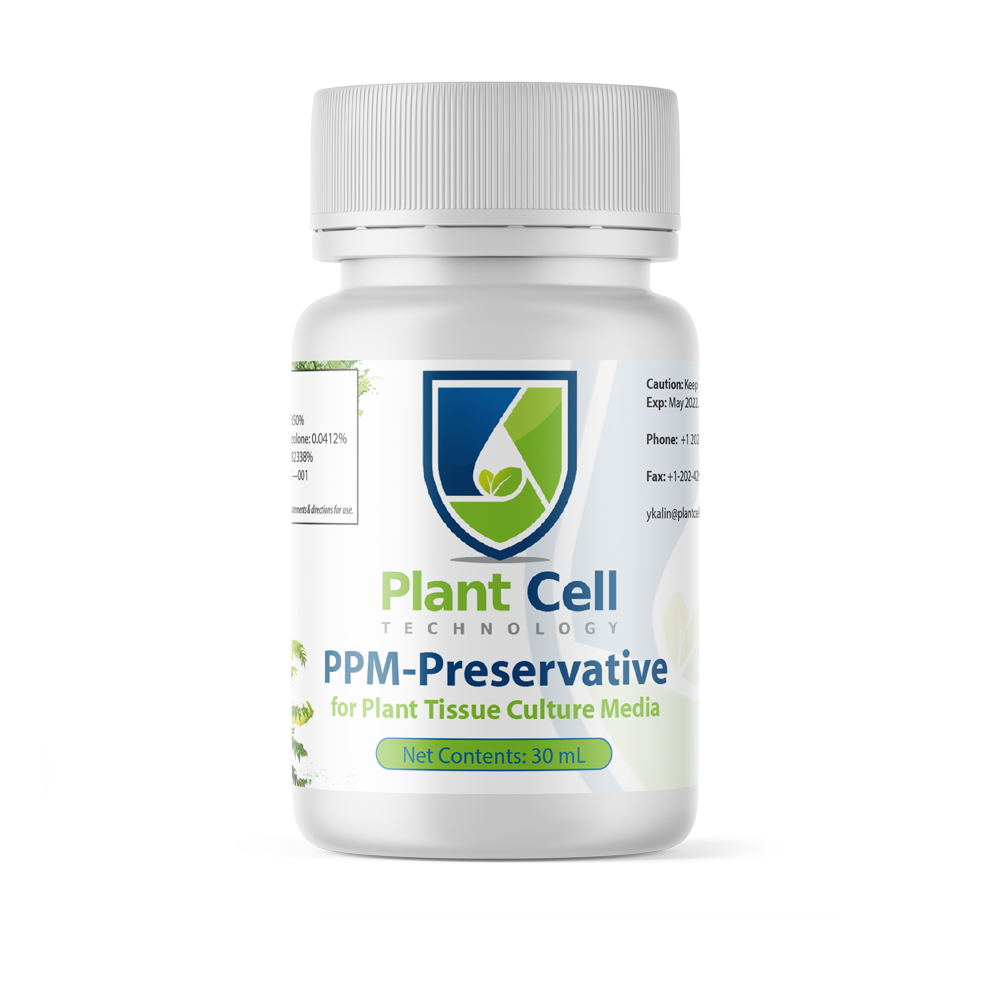
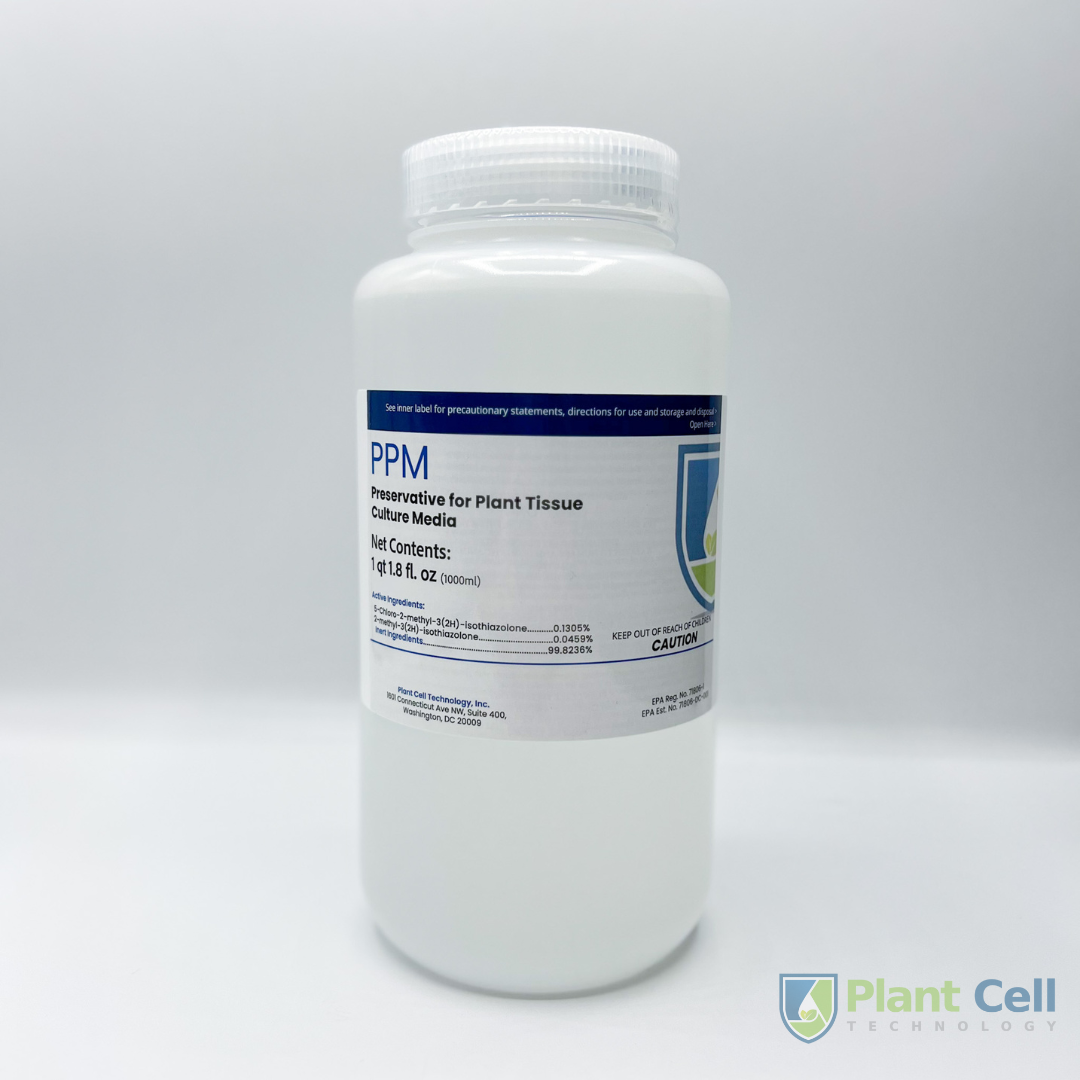
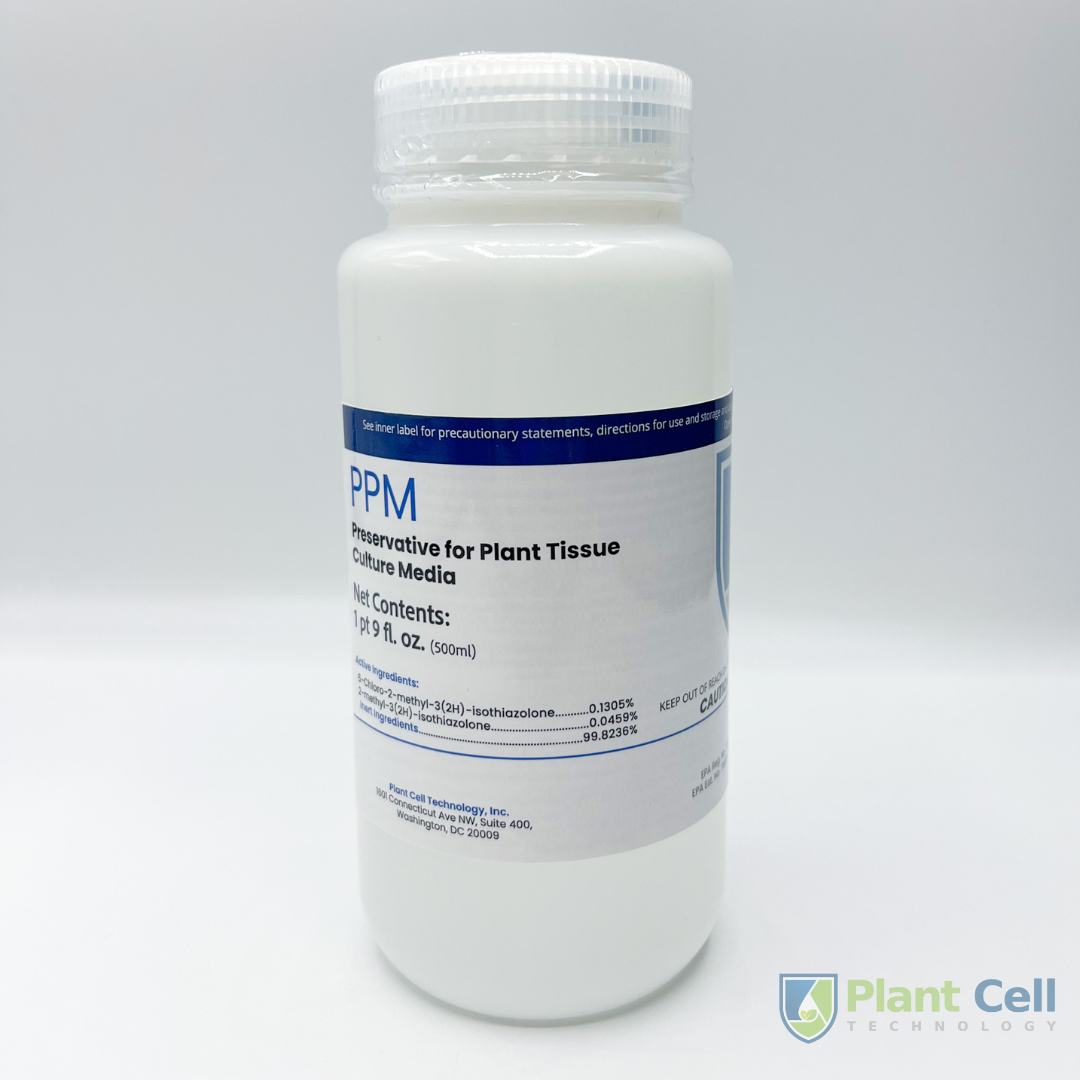
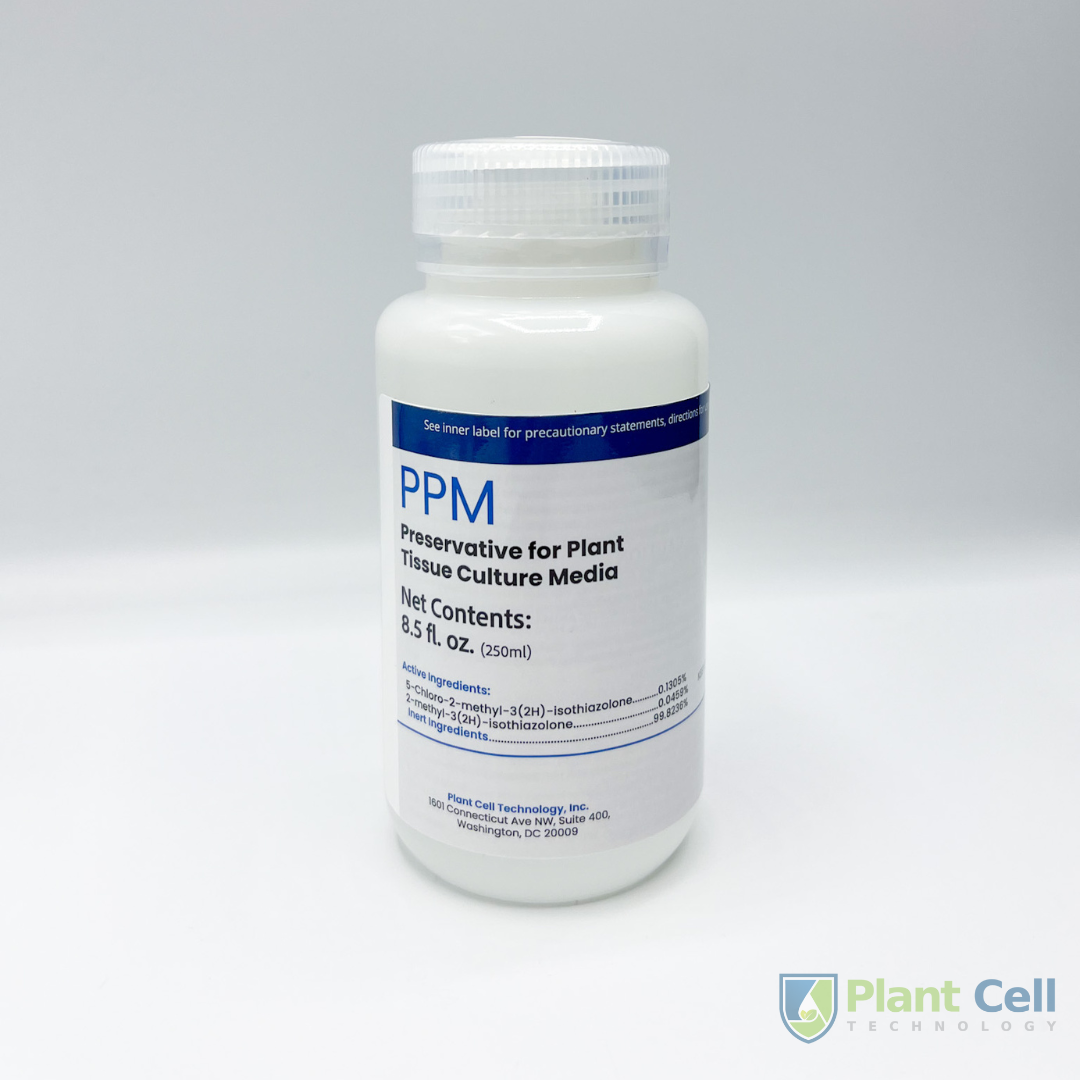
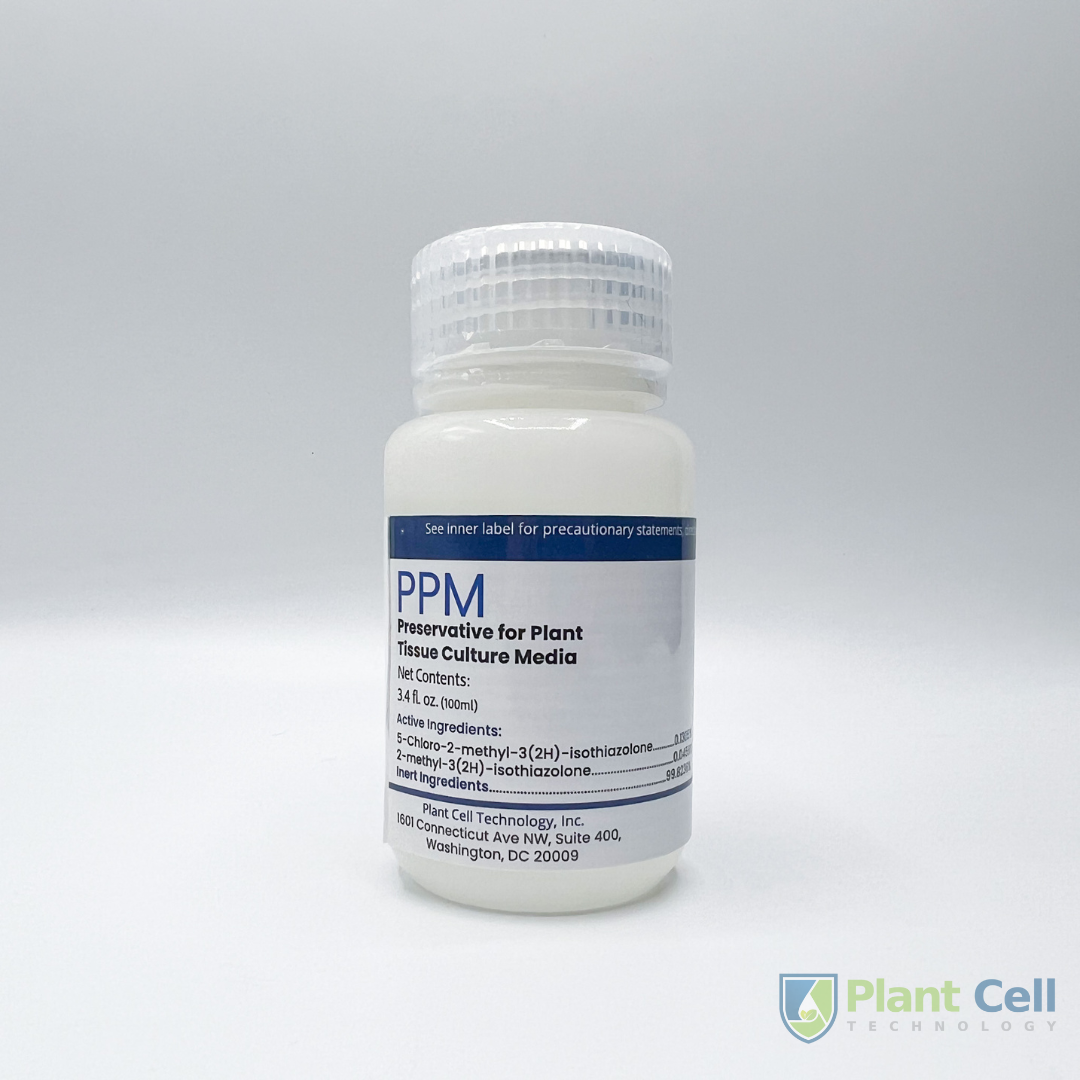
Plant Preservative Mixture (PPM™), is a broad-spectrum biocide/ for plant tissue culture. PPM™ is the ultimate solution to the never-ending struggle against microbial airborne, waterborne, and endogenous contamination.
Coupled with proper observation of aseptic laboratory techniques, PPM™ can increase your chances of a successful and thriving culture experiment.
The Benefits of Plant Preservative Mixture
- At optimum doses, PPM™, which stands for Plant Preservative Mixture™, is an extremely effective Preservative/Biocide, yet does not impair in vitro seed germination, callus proliferation and callus regeneration.
- PPM™ prevents the germination of both bacteria and fungi spores. It is heat stable and therefore can be autoclaved with the media.
- PPM™ can be, and should be used as a standard ingredient in plant tissue culture media, and is also substantially less expensive than commonly used antibiotics.
- While PPM™ was principally designed to inhibit airborne contamination, waterborne contamination, and contamination introduced from human contact, it can also -- in many cases -- be used to reduce endogenous contamination.
- PPM™ does not affect the genetic profile of the plants.
How To Use Plant Preservative Mixture?
- Follow the given steps to prepare the tissue culture media involving PPM™:
- Take a beaker and add 800 ml of sterile distilled water to it.
- To the water add PCT’s MS Media 4.54 grams (you don’t need to measure it as it comes in a measured bottle), 30 grams of sugar, and PPM™ (generally 1-2 ml/L of media based on the plants and contamination level.
- Add water to make 950 ml of the volume of the media.
- Adjust the pH of the media between 5.8-6.0.
- Add 8 grams of PCT’s Supreme Tissue Culture Grade Agar to the media and keep stirring.
- Make up the volume of the media to 1000ml.
- Autoclave the medium for 20 minutes at 15 psi and 121℃.
Your media is ready!
Product Name | Plant Preservative Mixture (PPM™) |
Feature | Autoclavable and heat stable |
Use | Preservative for plant tissue culture media |
pH | 5 - 7 |
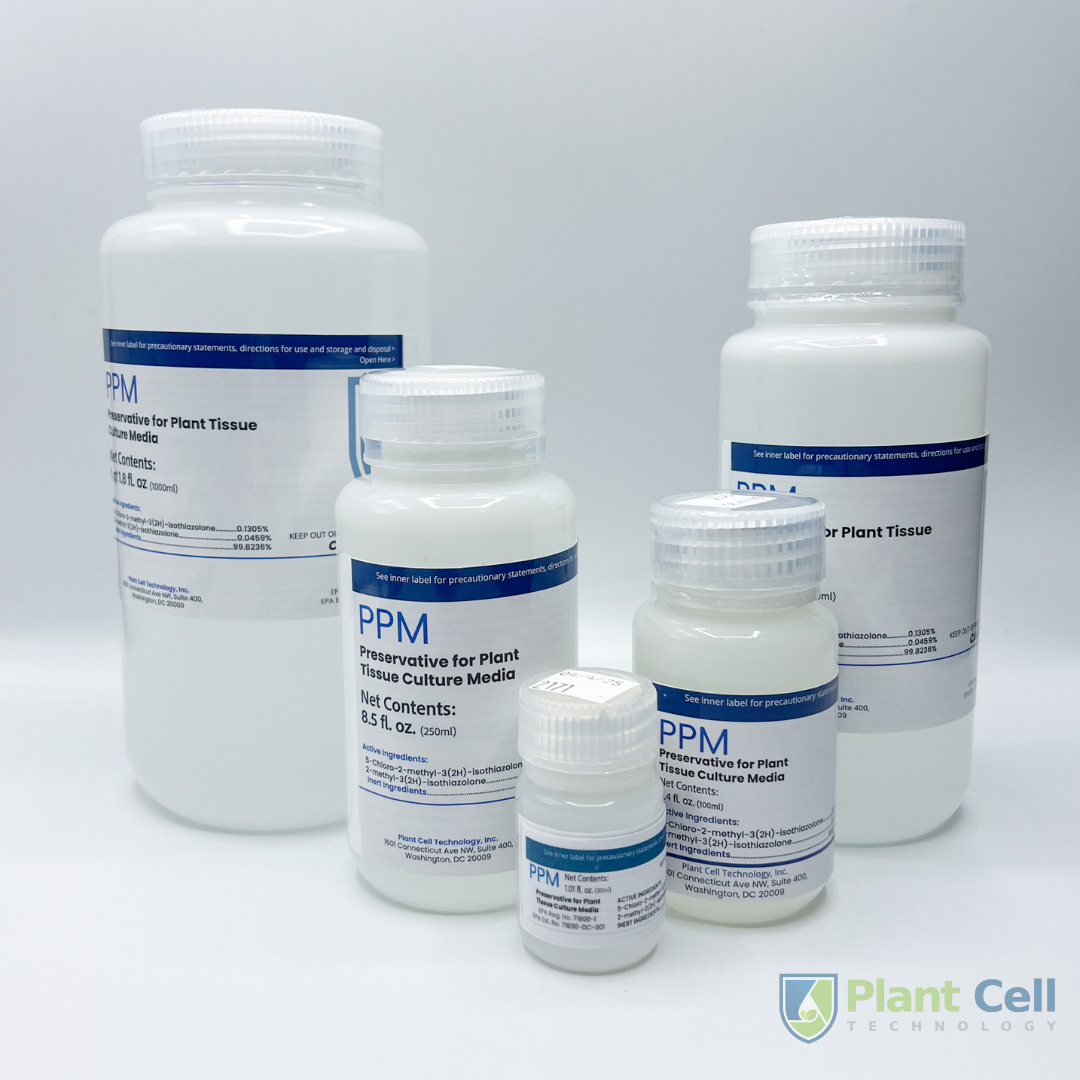
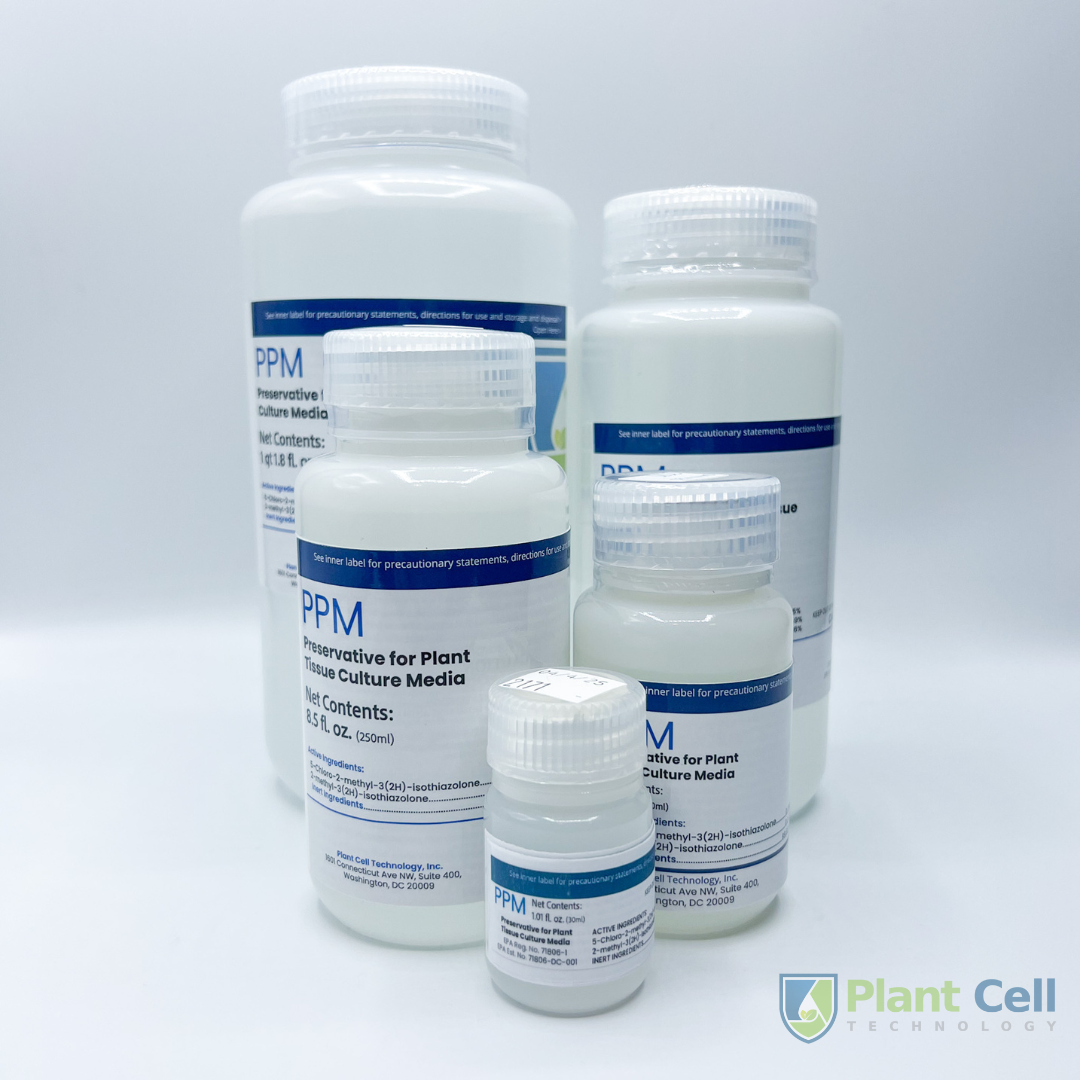
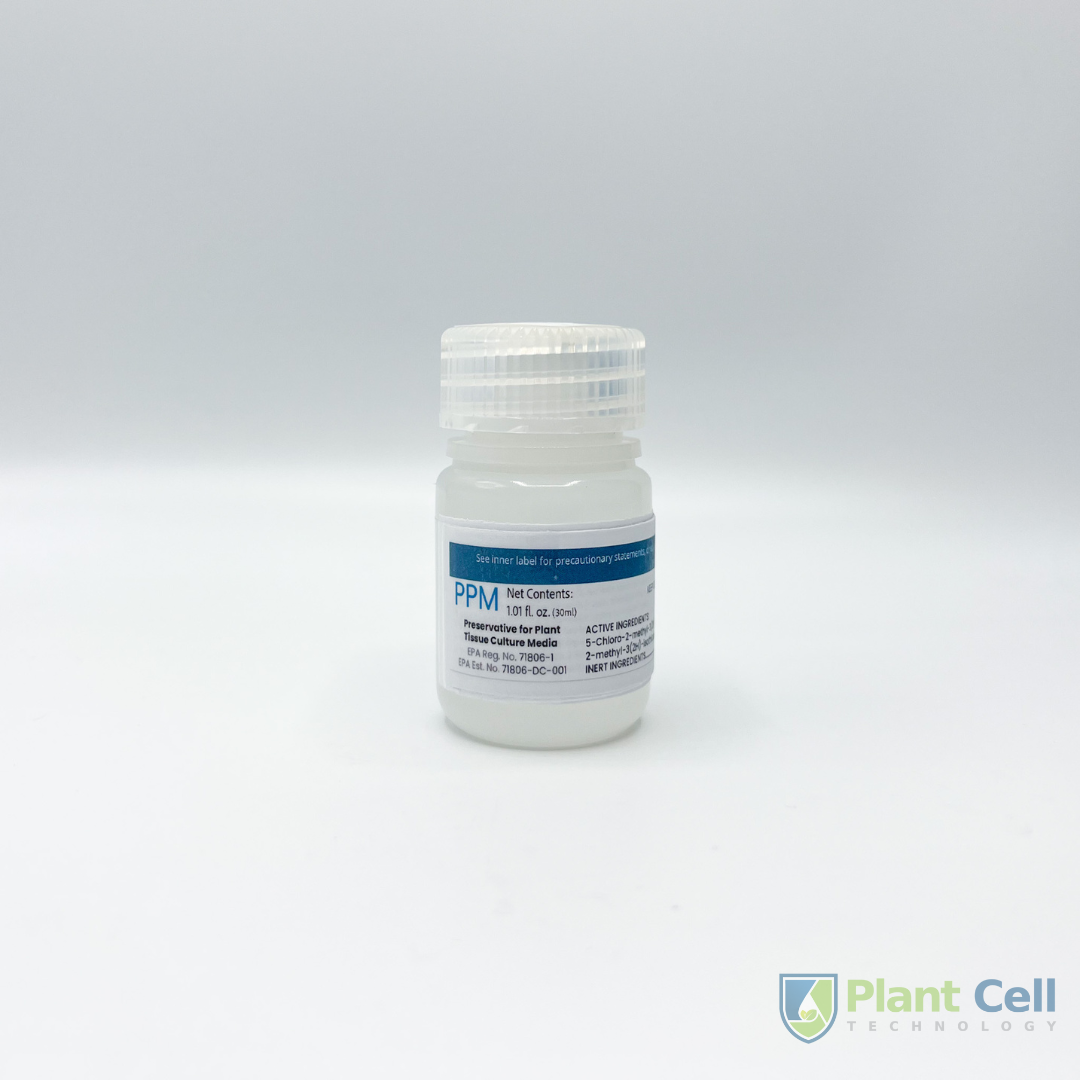
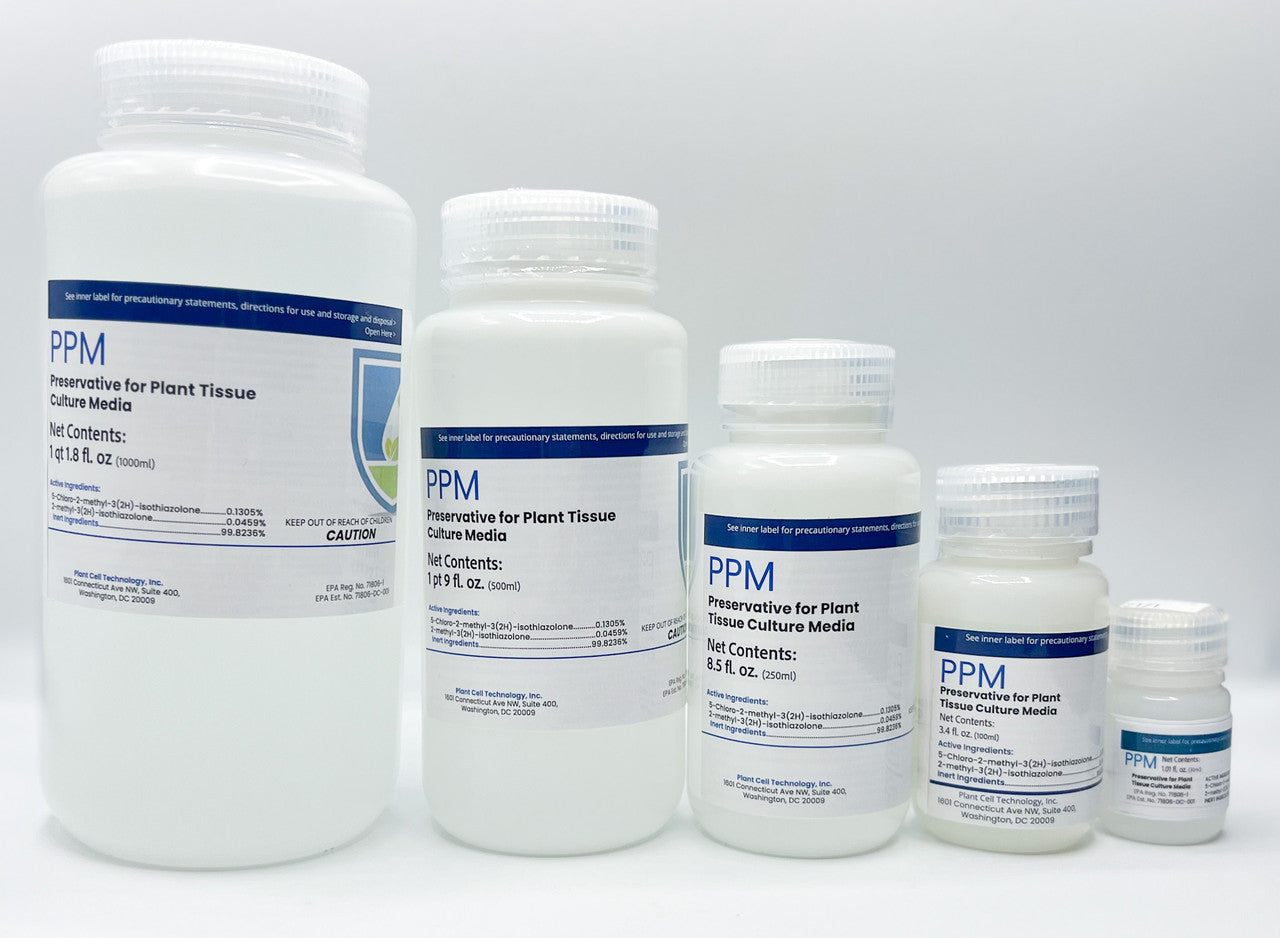
Capacity | Available in different volumes of 30mL, 100mL, 250mL, 500mL, and 1L. |
Shape | Cylindrical container |
Material | Liquid |
Color | Clear to light amber |
Odor | Mild |
Storage Temp | 39° F (4° C). |
HTS Code | 3808999000 |
Document:
Video Tutorials
Video Demonstration
What is Plant Preservative Mixture?
Plant Preservative Mixture (PPM™), is a broad-spectrum biocide/ for plant tissue culture. PPM™ is the ultimate solution to the never-ending struggle against microbial airborne, waterborne, and endogenous contamination.
Coupled with proper observation of aseptic laboratory techniques, PPM™ can increase your chances of a successful and thriving culture experiment.
The Benefits of Plant Preservative Mixture
- At optimum doses, PPM™, which stands for Plant Preservative Mixture™, is an extremely effective Preservative/Biocide, yet does not impair in vitro seed germination, callus proliferation and callus regeneration.
- PPM™ prevents the germination of both bacteria and fungi spores. It is heat stable and therefore can be autoclaved with the media.
- PPM™ can be, and should be used as a standard ingredient in plant tissue culture media, and is also substantially less expensive than commonly used antibiotics.
- While PPM™ was principally designed to inhibit airborne contamination, waterborne contamination, and contamination introduced from human contact, it can also -- in many cases -- be used to reduce endogenous contamination.
- PPM™ does not affect the genetic profile of the plants.
How To Use Plant Preservative Mixture?
- Follow the given steps to prepare the tissue culture media involving PPM™:
- Take a beaker and add 800 ml of sterile distilled water to it.
- To the water add PCT’s MS Media 4.54 grams (you don’t need to measure it as it comes in a measured bottle), 30 grams of sugar, and PPM™ (generally 1-2 ml/L of media based on the plants and contamination level.
- Add water to make 950 ml of the volume of the media.
- Adjust the pH of the media between 5.8-6.0.
- Add 8 grams of PCT’s Supreme Tissue Culture Grade Agar to the media and keep stirring.
- Make up the volume of the media to 1000ml.
- Autoclave the medium for 20 minutes at 15 psi and 121℃.
Your media is ready!
Product Name | Plant Preservative Mixture (PPM™) |
Feature | Autoclavable and heat stable |
Use | Preservative for plant tissue culture media |
pH | 5 - 7 |
Capacity | Available in different volumes of 30mL, 100mL, 250mL, 500mL, and 1L. |
Shape | Cylindrical container |
Material | Liquid |
Color | Clear to light amber |
Odor | Mild |
Storage Temp | 39° F (4° C). |
HTS Code | 3808999000 |
Document:
Video Tutorials
Video Demonstration
Share
BATCH CALCULATOR
How many liters of Medium do you need?
| Contributor | Plant Name | Contaminant ID | PPM concentration (mL/L) | Tissue Type/Application | Result / Comments |
|---|---|---|---|---|---|
| Dr. Ashish Dave | Malus rootstock | Fungi and Bacterial | 1ml/L | added to media | PPM @1ml/L added to Malus rootstocks shoot multiplication media. It was very effective in controlling bacteria, without causing any phytotoxicity and growth aberrations. |
| Richard P | Hemp | Fungi and Bacterial | 3% PPM | Explants | We wash explants 3% PPM in sterile water for surface sterilization and 3% PPM in MS Media for shoot initiation |
| Yaroslov Fuglevich | Paulownia | Bacteria and fungus | 1ml/L | Use PPM in the culture media, added before sterilization | very effective, does not cause phytotoxicity |
| Arthur P | Philodendron Pink Princess | Fungi and Bacterial | 1 mL/L | Explants | 40mL/L & 0.5mL/L philodendron pink princess Explants were washed in 4% PPM and were inoculated on media with 0.05% PPM no infections . |
| Matt Miller | Venus Flytrap | Fungi and Bacterial | 1 mL/L | Explants and Seeds | Put PPM in media pre-autoclave. Dramatically reduces contamination on both seeds and explants. |
| Patrick **** | Ceropegia Genus | Bacteria and Fungi | 2 mL/L | Stem Explant | Added to media prior to autoclaving. Prevents contamination. |
| Safa Labidi | Potato | Bacteria | 1ml/L | Shoot/Callus | used 1ml/l in our culture media to avoid contaminants |
| Md Faruk Hossain | Aloe Vera | Rhizome | 2 mL/L | Prior to autoclave | |
| Natalia Martinez-Ochoa | Tobacco | Fungal and bacterial | 2 mL/L | Leaf midvein and callus tissue culture. PPM is added to tissue culture media when it is being prepared, before or after autoclaving | Very Effective in preventing contamination |
| Hasnorita Abdul Rahman | Pineapples | Fungal | 2 mL/L | Sucker | Put onto medium, very effective to reduce contamination rate |
| Dr. Kamlesh Patel | Lonicera Species | Bacteria | 1 mL/L | Actively Growing Shoot Tips | Very Effective in preventing and eliminating bacteria in tissue culture |
| Yengl Gukh | Bean | Fungus | 100ml purchased | leaf | Incredible fungal removal effects were seen in callus cultures |
| Jennie | Coconut | bacterial | 0.1 ml/L | embryo | 0.1ml/L PPM were incorporated into tissue culture media |
| Mareid Glediee | Yuzus | Bacteria | 2 ml/L | Shoot | It was used for disinfection when preparing sections in tissue culture |
| MARIA LOURDES VICENTE | Pepper | bacteria | 50ml purchased | anthers | surface sterilization, in media |
| Petolescu Ceraselaz | Rubus fruticosus | bacteria and fungus | 2 mg/L | I use PPM in the culture media, added before sterilization; | very effective |
| Eliseo Tesón | Drosera,Nepenthes,Dionaea | bacteria and fungal | 2 mL/L | Leaf pullings and Seed sowing | I do use PPM when other disinfection procedures do not work, for example leaf pullings in drosera. Also I do use it when I exchange flasks with other people that already used PPM as a preservative i do add PPM if i have to replace the seedlings. Also a rinse of PPM after sterilizing Nepenthes seed with NaDCC has proben to be very effective to kill the remaining bacterial contamination. |
| Innan Godínez García | Vanila planifolia (Vainilla) Orquídea | bacteria, yeast, and fungi | 1 mL/L | 319/5000 The explants were washed with a Tween 20 1ml / L solution for 20 min outside the laminar flow hood. Inside the hood they were subjected to a 10% chlorine solution for 20 min and 2 drops of Tween 20 in 100ml of water. Then they were left in PPM for 10min. and were planted in MS 1/2 medium with 0.5 ml / L of PPM apical meristem and node | very effective |
| Carlos Urrutia | Orchid | 1 mL/L | apply it after sterilization | ||
| Jesus Lucina Romero | Blueberry | bacterial | 0.5 mL/L | Shoot | Add 0.5ml/L before sterile de medium |
| Daniel Zavala Ortiz | Tetrastigma | 2 mL/L | suspension culture | Preventing contamination during bioreactor cultures | |
| Jeanmarie Molina | Taxus Globosa S | 0.5 mL/L | stem, root | Preventing contamination during bioreactor cultures; | |
| Remi Bonnart | Vitis (Grape) | endophytic bacteria | 15 mL/L | Nodal Segments; | Helpful to control endophytic bacteria in Vitis shoots taken from potted plants and introduced to tissue culture for several weeks with minimal/no toxic effects |
| Hail Z. Rihan | Cauliflower | 0.5 mL/L | Cauliflower microshoots | The use of 0.5 mL L−1 of PPM with culture medium was found to be effective in controlling contamination and keeping the growth capacity of microshoots. | |
| Matilde E. Uribe | Traubia modesta | Bacterial | 1 mL/L | Bulbs of T. modesta(Roots, the upper-third of the stem, and dry outer scales were removed) | Bacterial contamination could be efficiently controlled with streptomycin and PPM |
| Dawood Ahmad | Curcuma, Kaempferia and Zingiber | Endogenous Contamination | 2 mL/L | Buds | Preservative mixture (PPM) treatment which helped to minimize the endogenous contamination. |
| Junji Miyazaki | Petunia hybrida | 5 mL/L | Upper young axillary buds | 1. HPLC revealed that axillary buds from upper young nodes absorbed significantly more PPM compared with those from the lower nodes. 2. Indexation indicated successful eradication of bacterial contaminants from upper young axillary buds after vacuum-infiltration with 5 ml l−1 PPM | |
| Sergei Krasnyanski | Cotton | 1 mL/L | Cotton seeds | Plant preservative mixture rinses were also included in the sterilization procedures to improve the efficiency of tested protocols. | |
| Pedro Sansberro | Ilex paraguariensis | 3.5 mL/L | Nodal segment explants of Ilex paraguariensis | ||
| Timothy A. Rinehart | Hydrangea macrophylla (Thunb.) Ser. and Hydrangea paniculata | 2 mL/L | Hydrangea seed | 0.5× Gamborgs solid media in conjunction with Plant Preservative Mixture (PPM), and by sterilizing seed with trichloro-s-triazinetrione (Trichlor). Assays of physiology were conducted by sterilizing seed. | |
| Junji Miyazaki | Black kangaroo paw | 5 mL/L (under vacuum) | Infected axillary buds and basal-stem calli | Indexation of plantlets raised from PPM-treated tissues indicated successful eradication of the endophyte from basal-stem calli, and from shoots regenerated from them. | |
| Freddy Mora | T. modesta | Bacterial, Fungal | 1 mL/L | The bulbs of T. modesta | The contamination was only by fungi because the bacterial contamination could be efficiently controlled with streptomycin and PPM as biocides. |
| Gustavo Zapata | Carnivorous Plants (Dionaea) | Fungus | 1 mL/L | Leaf | prepare media with MS |
| Mike **** | Ficus carica | 2 mL/L | Shoots | Media supplement and explant disinfestation | |
| Gemplant b.v.b.a | Cortaderia | 1-2 ml/L | add to medium before autoclavation | ||
| Omobolanle Ade-Ademilua | Peperomia pelucida | Endophytic bacteria, Fungi | 40mL/L and 0.75mL/L | Leaf | 40mL/L was used in disinfecting explants and 0.75mL/L added to media (solid) |
| Jorn Hansson | Gerbera, orchids, perennials | 1mL/L | Shoots | mixed in media right after sterilization | |
| Issaac Reyes | Cephalotus follicularis | Fungus, Bacteria | 80mL/L | Seeds | 80ml/l, Soak seeds in 0.8ml ppm/10ml water+1/3MS media, FREE PGR'S, Sucrose, No pH Adjust for 3-4 hrs. Desinfection for cephalotus follicualris seeds |
| Margaret Clark | Native hawaiian seeds | 1mL/L | Seeds | To blotter paper in petri dishes | |
| Dr. Kamlesh R. Patel | Lonicera | Bacterial | 1mL/L | Shoot | Added to the culture medium |
| Kun Wei | Norway Spruce | Bacterial | 0.5 mL/L | Somatic Embryos | Prevent the possible infections from handling. |
| Xinlu Chen | Hornwort | Fungus | 1 mL/L | leaves | controlling fungi |
| Katrina Dlugosch | Centaurea spp. | 1 mL/L (1% by volume) | Seeds | Germination of seeds | |
| Oleg Bosyy | Vaccinium | 1.5 mL/L | Shoots | addition of PPM to the medium | |
| Issaac ****** | Dionaea Muscipula | Fungus, Bacteria | 2 mL/L | Leaf | Add 2ml/l in MS media and sterilize. |
| Dr. Raquel Folgado | Aloe | 0.05 - 0.1 mL/L | Shoots | ||
| Dr. Raquel Folgado | Magnolia | 0.05 - 0.1 mL/L | Shoots | ||
| Dr. Raquel Folgado | Avocado | 0.05 - 0.1 mL/L | Shoots | ||
| Dr. Chunsheng Lu | Berries | 0.5 - 5ml/L | Shoot Tip | ||
| Manmeet Singh | Potato | 1.2ml/L | Stems | ||
| Martha Orozco | Asperagus | 10 mL/L | |||
| Martha Orozco | Tomato | 10 mL/L | |||
| Martha Orozco | Rice | 10 mL/L | |||
| Osagie Idehen | Fern | 1 mL/L | |||
| Osagie Idehen | Sweet potato | 1 mL/L | |||
| Jayakumar Pon Samuel | Maize | 1mL/L | |||
| Jayakumar Pon Samuel | Soybean | 1 mL/L | |||
| Jayakumar Pon Samuel | Canola | 1mL/L | |||
| Mr. Micah Stevens | Juglans | 2 mL/L | Shoots | ||
| Dr. Jiping Zhao | Petunia | 2 mL/L | Leaf | ||
| Dr. Qingzhen Jiang | Alfalfa | 3 – 5 mL/L | Leaf | ||
| Dr. Qingzhen Jiang | Medicago | 3 – 5 mL/L | Leaf | ||
| Dr. Qingzhen Jiang | Switchgrain | 3 – 5 mL/L | Leaf | ||
| Chetty Venkaterwen | Rice | 3.5 mL/L | Seed/Embryo | ||
| Chetty Venkaterwen | Ciban | 2 mL/L | Leaf/Shoot | ||
| Chetty Venkaterwen | Tomato | 2.5 mL/L | Seedlings | ||
| Kaitlin J. Palla | Clusia | 5 mL/L | |||
| Kaitlin J. Palla | Kalanchoe | 5 mL/L | |||
| Kaitlin J. Palla | Poplar | 5mL/L | |||
| Jim Bo | Orchids | 0.3 mL/L | Nodes | Growing orchids | |
| RUANGWIT PORRUAN | Nepenthes | 1-2 mL/L | Shoot | Add 1-2 mL/L PPM to media before sterilization. | |
| Annie Lachapelle | Rosa hybrida | 10 mL/L | Shoot | Mix with culture | |
| Quoirin M. | Bambusa | Fungi and bacteria | 3 ml/L | shoot segment | Desinfestation for introduction in vitro |
| armin mustafic | orchid | 1 mL/L | leaf | Great, five star product! | |
| Dr. Kamlesh R. Patel | Hosta | 1 mL/L | bulb | Liquid Culture | |
| Naoaki Okamoto | Nepenthes | 5ml/L | seed | In vitro culture of Nepenthes | |
| Marc Martinez | Sarracenia | Bacterial | 1 mL/L | seed | Bacterial and fungal prevention for in vitro multiplication. |
| William Conner | Citrus | 4 mL/L | Shoot / Tip | eliminates fungus, does not seem to have effect on plant | |
| Michelle Steenberghen | Cortaderia | 1.5ml/l | shoots | add before autoclavation | |
| Choo ******** | OIL | 40mL/L & 0.5mL/L | SEED | Explants were washed in 4% PPM and were inoculated on media with 0.05% PPM | |
| Erin ***** | Canola | fungal | 1 mL/L | callus, shoot | to be added to tissue culture media |
| Dr. Kamlesh R. patel | Elm | Bacterial | 1 mL/L | shhot tips | In agar solidified medium. |
| Hoang Tuan Vu | Wasabi | 1 mL/L | Shoot | Plant preservertive mixture | |
| Deborah McCown | Amelanchier | Bacteria and Fungi | 0.5 ml/L | Shoot Culture | Tissue Culture media |
| Maria Consue Medina | blueberry | Bacterial | 2 mL/l | shoots | before autoclave in the culture media |
| Carolina Rugeles | Ornamentals | Bacteria, Fungus | 2 mL/l | Tissue Culture | Prepare in the Media solution |
| Natalia Campistany | cucumber | Endogenus bacteria | 1 mL/L | plant | mixed in the solid media |
| Obaid ur Rahman | banana | Fungal, bacterial | 1 mL/L | shoot tip cultures | PPM added at a concentration of 1 ml/L in liquid culture media and sterilized for 5 mins and 121 degrees centigrade |
| Meenakshi Santra | Wheat | 0.5ml/l | wheat embryo culture | we use in regeneration media and sometimes to kill the fungi in regenerated plants | |
| Desiree Ho | Cantharanthus | 0.01 mL/L | Nodes and shoot meritsem | Preventing microbial contamination in tissue culture media. | |
| Joanna ***** | maize | Aspergillus | 2 mg/l | embryo | Soke overnight |
| Chan Woei Yee | Anubias | Bacterial | 1 mL/L | Corm | Plant Maintenance |
| Bruno La Rosa | Nepenthes | Fungi spores, bacteria | 1 mL/L | Seed | 1 mL applied to 1 L of MS Basal medium mixture with sucrose and BAP. |
| Joshua Spece | Hosta | 1-2 mL/L | meristem bud | PPM used in the media. Greatly improves contamination rate. | |
| Julie ***** | raspberry | 1 mL/L | shoot | use on contaminated cultures that we must continue to multiply | |
| Maria Consue Medina | Blueberry | Bacterial | 2.5 mL/L | Shoots | Before autoclave |
| Gerardus VanDerMeij | Impatiens | Bacterial | 1 mL/L | Shoots | Used in propagation to keep cultures clean |
| Viji ****** | Orchids | 1 mL/L | Shoot | Media preparation and cleaning tissues | |
| Md Faruk Hossain | Aloe Vera | Rhizome | 2 mL/L | Prior to autoclave | |
| Leong MY | Mango | Leaf | 0.2 mL/L | Cloning | |
| Paulownia | Bacterial and Fungus | 1 mL/L | In the culture media and prior to sterilization | Very effective, does not cause phytotoxicity |
I have a professional setup so i don't have problems with contamination, so i don't use PPM all the time. I do back up strains for long term storage and use it for that. I feel safe that if some contamination does find its way into the vessel, that it will not grow.
I use 1.5mL of PPM per liter of MS media for Ribes propagation and have much less contamination issues than without. I use it for all now.
We are happy with the advantages that we see when using PPM. It definitely has improved our tissue culture work.
I love this stuff! I don't know what I would do without it! Thank you for providing a high quality product at a good price!
I am a beginner hobbyist in Plant tissue culture and this PPM has made life so much easier, which a greatly decreased contamination rate. Really quick shipping and super helpful when Ive had questions.